
AI6 min read
Is AI a Bubble? What the November 2026 Crash Means, From Someone Who Builds AI
AI stocks crashed in early November 2026 and everyone is asking if AI is the new dot-com bubble. Not a finance take: a plain-language view from someone who builds AI products every day, on why the technology is real, what looks fragile, and what companies building with AI should do now.
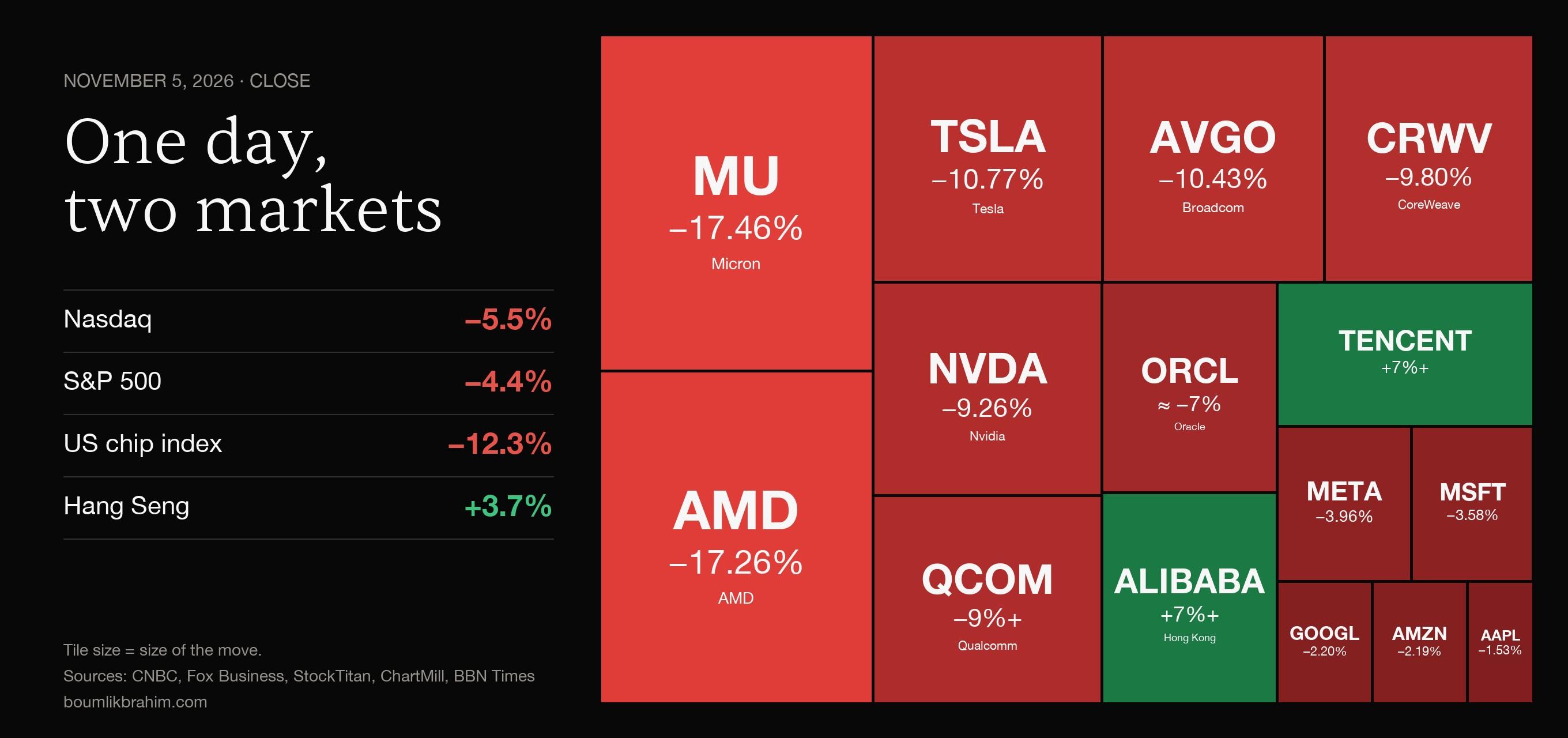
Quick answer In the first week of November 2026, AI stocks fell hard, and everyone started asking if AI is a bubble like the internet in 2000. I'm not a finance person. I build AI products for a living. From where I sit, AI is not a bubble: people use it and pay for it every day. What looks fragile is the money being spent on it, much of it on promises. If that part breaks, AI won't disappear. It will most likely get cheaper, and for people who build with it, that is good news.
What Happened, Briefly
On November 5, 2026, Nvidia, the company that makes most of the chips AI runs on, lost about 9% of its value in one day, and the Nasdaq, the main index of US tech companies, fell 5.5% (Fox Business). The trigger was worry about data centres, the huge buildings full of computers where AI runs. Rising electricity prices have turned them into a political issue (Fox Business), 61% of Americans now oppose a new one near their home (Annenberg Public Policy Center), and after the US midterm elections investors feared new limits on building them (CNBC). Tech stocks were already showing signs of recovery the next morning (CNBC).
Where the Worry Comes From
The simple version: a few companies are spending enormous amounts on AI before the money comes back. Amazon, Microsoft, Google and Meta plan to spend about $730 billion on buildings and equipment in 2026, most of it for AI data centres and chips (ValueAdd VC). OpenAI, the company behind ChatGPT, has committed to more than $1 trillion of computing power between 2025 and 2035, by one analyst's count (Tomasz Tunguz), while it is on track to earn about $50 billion a year (Bloomberg Government).
Part of that money also goes round in a circle: Nvidia put $30 billion into OpenAI in February, and the deal comes paired with years of OpenAI commitments to use Nvidia computing power (TheNextWeb). Think of a shop lending money to a customer so the customer can buy from the shop. Sales look great, as long as the customer can pay it back.
Is This the Internet Bubble Again?
In the late 1990s, everyone was sure the internet would change everything, and they were right. But too much money went too fast into companies that made nothing yet, and in 2000 it crashed (Wikipedia). The internet itself survived. Only the overpriced bets didn't.
| Question | Internet, 2000 | AI, 2026 |
|---|---|---|
| Do people actually use it every day? | Not yet | Yes |
| Do the leading companies make money? | Mostly no | Yes, a lot |
| Is a lot being built on promises and loans? | Yes, internet cables | Partly, AI data centres |
| Do most businesses get their money back from it? | Not yet | Only a minority |
So my honest answer is: the technology is not a bubble, but part of the spending around it might be. And the best part of the 2000 story is what came after. Far more internet cable had been laid than anyone needed, and much of it sat unused after the crash (Wikipedia). That spare capacity kept internet connections cheap, and in my view it is part of why things like YouTube and the cloud could take off in the years that followed. If AI spending cools down, I expect the same thing: more computing power than demand, and lower prices for everyone who uses it.
What I See From Inside
I lead engineering at Camelo, where we build AI products used on the web, on desktop and on phones. Before that, I added AI to a live product used by real customers at Fygurs (I wrote about it here). Every day, I see people rely on these features to do real work. That is not what a bubble looks like from the inside. What I watch is not the stock price. It's the bill.
Two things in the news matter more to me than the crash itself:
- AI is already getting cheaper. By May 2026, open models from Chinese labs like DeepSeek and Qwen, which anyone can download for free, handled about 61% of all the text processed on OpenRouter, a service developers use to access many AI models (DataGravity). The price pressure is real, and it is good for anyone building products.
- The companies we depend on can change overnight. If money gets tight, some AI providers will be bought, raise their prices or close. A product tied to one of them inherits that risk.
So here is what I'd tell any company building with AI, bubble or not:
- Never depend on a single AI provider. Build so you can switch models without rewriting your product.
- Count the cost of each finished job, not the advertised price. A cheaper model can cost more if it needs more work to finish a task. I showed why in The Cheaper AI Model Can Cost You More.
- Prove the value before spending big. When money is easy, companies pay for ambition. When it gets tight, they keep only the AI features that clearly save more than they cost. Build those first.
For businesses outside the US and China, including here in Morocco, a cooler AI market is mostly an opportunity: cheaper tools, more choice, and less hype to compete with. The teams that win won't be the ones who spent the most. They'll be the ones who built something people actually use.
Sources
- Fox Business, Nasdaq tumbles 5%, Dow plunges more than 1,800 points
- CNBC, AI stocks hammered by midterm shock
- Annenberg Public Policy Center, Opposition to local data centers rises sharply
- ValueAdd VC, Big Tech AI spending 2026
- Tomasz Tunguz, OpenAI's $1 trillion infrastructure spend
- Bloomberg Government, OpenAI's revenue run rate nears $50 billion
- TheNextWeb, Nvidia tops $40bn in AI equity bets in 2026, anchored by $30bn OpenAI investment
- DataGravity, China's open-weight takeover
- Wikipedia, Dot-com bubble and Dark fibre
A note: this article covers November 1 to 7, 2026. I'm an engineer, not a financial analyst. This is my view as someone who builds AI products, not investment advice.
You might also like The Cheaper AI Model Can Cost You More and How to Configure AI Coding Agents Like an Engineering Team.
Working on something similar?
I'm a Technical Lead & AI Engineer building LLM-powered SaaS in production.
NestJS, Next.js and Django on Azure, from model integration to the architecture around it. If your team is working through the same problems, I'm happy to compare notes.